Capption vs.
QR codes + mobile webpages
Most museum prospects we spoke with had tried QR code-triggered exhibit information at some point. Most had given up. Our early clients described those systems as functional but considerable administrative hassle—especially in light of weak results for visitors who needed help the most.
At a glance
NFC + purpose-built app
Capption
Capption uses NFC tags—small passive chips that require only one action: hold your phone near the tag, just like Apple Pay or Google Pay. A purpose-built app processes the payload into an accessible, settings-aware experience that's up to 6× faster than QR + mobile web for visitors completing the same task.
QR codes + browser
QR Codes + Mobile Webpages
QR codes trigger a phone's camera, which decodes a URL, which opens a browser tab, which loads a webpage. In theory this is four steps. In practice, it's thirteen—each one a potential failure point for visitors with vision, mobility, or cognitive differences.
The origin and pervasiveness of QR codes
Back in the optimistic early 1990s, automotive parts suppliers were slapping as many as ten separate barcodes onto produced parts just to communicate the ever-increasing amount of tracking and identity information. Standard barcodes can only be read one way, so on an irregular shape like a control arm or power steering pump, scanning failures slowed down production.
A game of Go spurred Masahiro Hara's brainwave. Hara-san realized a grid could hold considerably more information than a standard barcode—and be read correctly from multiple angles. In 1994, his team at Denso Wave invented the Quick Response Code. Crucially, Denso Wave open-sourced the format, catalyzing worldwide adoption.
QR codes stayed primarily in Japan throughout the 90s and early 2000s. As Japanese manufacturing methodology spread globally, their use expanded but remained largely confined to logistics. In the mid-2010s, QR codes appeared in day-to-day life as triggers for mobile payment systems. Then 2020 arrived. The COVID-19 pandemic necessitated touchless interactions, and QR codes became an instrument of public health. They're still ubiquitous—and most frequently seen at restaurants and in advertisements.
The museum world noticed. Unfortunately, so did museum visitors.

What using a QR code actually looks like
Everyone knows the four-step theory. Here's what really happens.
In theory
- Open your camera
- Scan the QR code
- Tap the prompt to open the URL
- View the content
In reality
- Locate the code
- Decide whether it's worth pulling out your phone
- Unlock your phone
- Open the camera application
- Frame the code in the viewfinder, trial-and-erroring the correct angle
- Wait for the camera to focus
- Adjust distance and/or illuminate the code if necessary
- Tap the resulting pop-up link
- Beat through any browser selection or related prompting
- Wait for the browser to launch
- Wait for the browser to load the page, downloading megabytes of headers, trackers, and client-side scripts
- Pray it's not a "quishing" scam
- At last—view the content
The real cost
That whole process requires a baseline level of visual acuity, manual dexterity, physical mobility, technological familiarity, available connectivity, and patience that not all visitors bring with them. Our primary research found that disabled exhibition visitors considered QR codes undignified—if not outright ableist.
QR codes are for logistics, not people
Most mildly-aware technology professionals have known this for decades. We've also known about alternatives to QR code activation (triggers) and to web browsers (interfaces) for just as long.
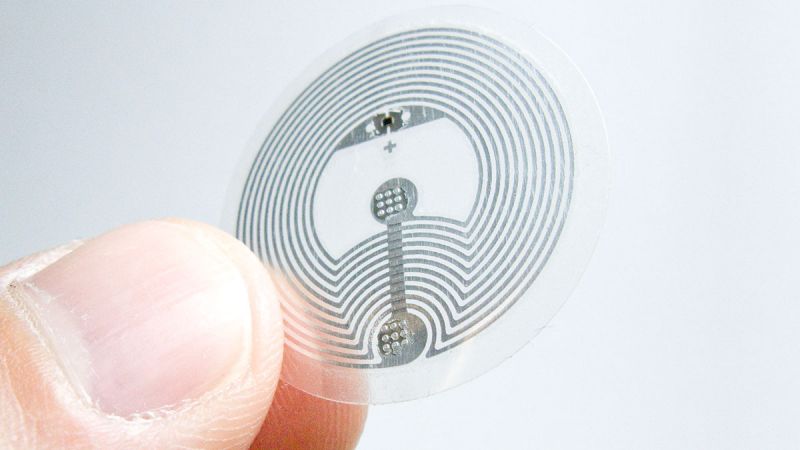
Think of passive NFC tags—those little circular stickers—as inert radios powered by other radios. When they're hit by the right signal, they send a very short-range signal back. That signal contains data your phone can use, and the technology's send-receive-utilize loop requires only one user action: placing the phone within two inches of the tag itself. A much more human-friendly trigger.
The interface's job is to process a data payload into something the user can view or act on. While the web browser has been revolutionary, it's a very heavy, grossly generic, and surprisingly restrictive tool in modern form. Mobile apps purpose-built for specific data types produce usable, accessible, performant interfaces that respect users' pre-existing settings—something a browser can only approximate.
Given the friction described above, QR codes were a non-starter for Capption. We primarily use an immediate, tap-to-open, NFC-triggered workflow. Visitors tap their phone to the physical Capption tag just like using Apple Pay—bypassing the need to focus a camera or navigate a screen entirely.
Technically Capption supports QR codes too. But as a bonus, Android- and iOS-specific NFC enhancements let Capption perform without requiring visitors to search for and download our app first. One tap, and that's it.
Why Capption doesn't use mobile webpages
We certainly could have built Capption on mobile web. Here's why we didn't.
01
Forced prompting
QR code URLs force a browser selection or redirect prompt in both Android and iOS—every single time.
02
No default bypass
Mobile OSes have no mechanism to remember a default browser for QR-triggered URLs, so the selection dialog always reappears.
03
Tab proliferation
Each scan opens a new browser tab. Visit six exhibits and you're managing six open tabs—or abandoning them in an ever-growing pile.
04
History intermingling
Exhibit content gets folded into the visitor's browser history alongside everything else, leaving no clean way to revisit specific pieces.
05
Poor performance
Modern mobile web delivers suboptimal performance with standard payloads and awful performance with some CMSes and infrastructure.
06
Slow media loading
Audio and video support is slow and unreliable in browser contexts. Standard web payloads are heavy; CMS-generated pages can be brutal.
07
No hardware API access
Browsers can't talk directly to the phone's accessibility stack, font engine, or native media controls. Apps can—and Capption does.
08
Surveillance by default
Browser sessions interleave visitor behavior with first- and third-party tracking systems. Exhibit curiosity shouldn't generate a data trail.
09
AI indexing exposure
Public web content is crawled and assimilated. Institutions' exhibit content shouldn't be quietly absorbed into Big Tech's training data.
10
No browser is truly accessible
Browsers are assistive at best—sometimes. Assistive technology deserves a platform built specifically for that purpose.
What Capption gives guests that QR codes and mobile webpages don't
Capption is assistive technology—not a standard mobile web application.
Much higher performance
Capption's payload is a lot smaller and simpler. Perfect for crowded WiFi networks in busy gallery spaces.
Exhibit-centric history list
No scrolling through browser history separating exhibits from everything else. Visitors can revisit any exhibit they tapped—whenever they want.
True visual accessibility
Capption's interface is built for access. We respect users' phone settings while enabling further customization—not just a WCAG checklist.
Minimal, user-controlled formatting
Unlike a fixed webpage design, the Capption app handles formatting on a user-by-user basis—font size, contrast, spacing, all of it.
Stronger native OS integration
Important for font rendering, screen reader support, and media playback. Capption speaks the OS's language because it lives in it.
Simpler administration
Capption administrators manage a few fields in plain markdown—not a web CMS's worth of HTML, templates, and breakpoints to quality-check.
No tab clutter
Each QR scan opens a new browser tab. Capption keeps exhibit content contained and organized, not scattered across a browser session.
No surveillance data intermingling
No browser cookies tracking behavior, no identifiable analytics. Curious visitors can explore without generating a data trail.
No AI indexing
An institution's exhibit content won't be quietly assimilated by Big Tech's large language models. It belongs to you—and your visitors.
Measurably faster
Our regular testing shows users can scan, comprehend, and close Capption 6× faster than completing the same task with a QR code and mobile webpage containing identical content.
The core difference
Capption is purpose-built assistive technology meant to quickly bridge a normally-excluded visitor's curiosity and your exhibit's context. A mobile webpage is your content on a webpage, in a format you design, producing an experience you can't guarantee.
Pricing QR codes against Capption
Institutions can implement a QR code-triggered exhibit information system for almost no money—but a fair amount of sweat and tears. Every exhibit requires its own page on the public website, then must be quality-checked at desktop, mobile, and every in-between breakpoint. Then you have to print and post QR codes everywhere—large enough to use, small enough to avoid looking aggressively gaudy.
Capption costs money. Our price starts remarkably small and increases based on institution visitor volume. As we keep hearing from customers, the administrative workload is extremely low compared to a web CMS or exhibit management tool. And it doesn't look like trash alongside priceless works.
Capption vs. QR codes + mobile webpages
If your team has nothing but time and you believe the average guest likes and can use QR codes, implement a QR-code/mobile-web exhibit content delivery mechanism. If you want to improve your general guest experience and actually help visitors with visual, social, language, memory, and mobility challenges, implement Capption.
As an extension of 20th-century logistics technology, QR-triggered mobile webpages force users to accommodate the hardware and software—focusing cameras, managing browser tabs, squinting at fixed designs. Capption reverses this paradigm by accommodating the user, providing a fast, legible, deeply integrated experience that gets out of the way so the visitor can focus on your art, science, or nature exhibition.
You can serve exhibit content innumerable ways. Which experience do your guests deserve?
Ready to make your exhibits truly accessible?
Compared to the old QR + mobile web paradigm, Capption makes life easier for everyone, and measurably better for many. A dignified, effective, and easy-to-implement solution that empowers visitors to explore their curiosity without stress or impediment.